Showing posts with label hobby. Show all posts
Showing posts with label hobby. Show all posts
07 December 2006
Radio-controlled helicopter
Now you can get radio-controlled helicopters for less than $200!! I want one...


12 October 2006
Link of the day: High dynamic range photography
Cameras have a very limited dynamic range compared to the real world. This means that even though an object illuminated in sunlight might have a wide range of brightness, the camera has much rougher palette of brightness. This makes it hard to see details especially when two objects are illuminated with different intensities (a person standing next to a bright LED sign). The technique of maximizing the dynamic range in photos is called HDR (high dynamic range). With the advent of digital cameras, people have developed new ways to achieve HDR photos. I found a really informative introduction to digital HDR here. Wikipedia also has some information on the subject. Here is a tutorial on HDR which I found via Lifehacker.
19 July 2006
Link of the day: "When Amateurs Roamed the Earth"
I enjoyed reading the article "An Exhibition About Drawing Conjures a Time When Amateurs Roamed the Earth" in the New York Times.
It made me try to think of various "hobbies" that people must have done in the pre-transistor era. My list includes sports, music, tinkering, drawing (like in the New York Times article), and dancing. Maybe I should set a personal goal of putting some serious effort into the activities I haven't tried.
I've always loved sports and have some physical talent, so this one has always been easy for me to do and enjoy. As a child, I did a lot of playground sports and formally soccer and basketball, although nowdays I pretty much stick to hockey.
The playground sports included touch football, rounders (also known as kickball), prisoner dodgeball, sock out (also known as handball) and wall ball (I can't remember the name; you basically throw a tennis ball against the wall). I hope children still make up their own games. Looking back, I'm amazed at the rules we invented for sockout and wall ball. For example, if you played sock out against a wall, you could run under the ball's trajectory instead of hitting ("doing a rainbow"). In conventional sock out (with no wall, just a painted box for a boundary), an easy way for the "server" to "waste" someone (get a person out) was to do a "toilet" serve. Instead of bouncing the ball to the opposing player (what you do when you serve), you bounce the ball to your friend next to you, who hits the ball to the player low and fast (what we called a "skimmer").
I also watched football, basketball, baseball, soccer, and the Olympics on TV and read the sports page from front to cover.
As for music, I play the piano (not very well), but when I play my favorite piece (Arabesque No. 2 by Claude Debussy), people seem really impressed. I should thank my parents for forcing me to take music lessons. I've never taken any courses in music theory, but I think my exposure to classical music at an early age has given me some good taste (I hope). I really like listening bluesy music (but not Bach: why do so many people like Bach??) and playing Debussy piano pieces. I don't play piano much these days, but I do try to listen to a variety of music including classical, bluegrass, country, swing, some jazz, and a little pop/rock.
So I guess I have sports and music pretty covered. Tinkering is a hobby I'm working on. I think the most intimidating part of tinkering is the fear of breaking something. I'm finally getting over that fear and lately I've been trying to learn about operating systems and computer hardware. This seems like a good way to enter the field of tinkering since computers are relatively resilent and there's tons of information on the internet. I haven't tried building my own furniture, doing house improvement, or re-wiring my remote, but perhaps someday. One thing that helps is that my dad fixes a lot of stuff. Even though I usually didn't watch him, I think I inherited some building intuition from him.
Dancing and drawing are non-existent activities for me. I did draw as a child (I liked drawing famous athletes and Monkey King from the Chinese novel "Journey to the West"), but I don't have any formal art education and haven't got any intuition about art either. I always end up spending a lot of time in museums reading the descriptions on the exhibits because I have no idea why the art is important or what the context is. A friend of mine suggested that I just look at the work and make up my own mind about it, which is a good idea to some extent, but it would be much easier if I knew a bit more.
As for dancing, I don't really like dancing. Neither am I really good at it. The problem is that you have to memorize a complicated set of movements that happen in rapid succession and I have a hard time developing the needed physical memory. (Hmm, maybe parents should add dancing lessons to the requisite sports and music training.) So I guess this is at the bottom of my list. Maybe my sister (a dancing freak) will convert me in the near future.
It made me try to think of various "hobbies" that people must have done in the pre-transistor era. My list includes sports, music, tinkering, drawing (like in the New York Times article), and dancing. Maybe I should set a personal goal of putting some serious effort into the activities I haven't tried.
I've always loved sports and have some physical talent, so this one has always been easy for me to do and enjoy. As a child, I did a lot of playground sports and formally soccer and basketball, although nowdays I pretty much stick to hockey.
The playground sports included touch football, rounders (also known as kickball), prisoner dodgeball, sock out (also known as handball) and wall ball (I can't remember the name; you basically throw a tennis ball against the wall). I hope children still make up their own games. Looking back, I'm amazed at the rules we invented for sockout and wall ball. For example, if you played sock out against a wall, you could run under the ball's trajectory instead of hitting ("doing a rainbow"). In conventional sock out (with no wall, just a painted box for a boundary), an easy way for the "server" to "waste" someone (get a person out) was to do a "toilet" serve. Instead of bouncing the ball to the opposing player (what you do when you serve), you bounce the ball to your friend next to you, who hits the ball to the player low and fast (what we called a "skimmer").
I also watched football, basketball, baseball, soccer, and the Olympics on TV and read the sports page from front to cover.
As for music, I play the piano (not very well), but when I play my favorite piece (Arabesque No. 2 by Claude Debussy), people seem really impressed. I should thank my parents for forcing me to take music lessons. I've never taken any courses in music theory, but I think my exposure to classical music at an early age has given me some good taste (I hope). I really like listening bluesy music (but not Bach: why do so many people like Bach??) and playing Debussy piano pieces. I don't play piano much these days, but I do try to listen to a variety of music including classical, bluegrass, country, swing, some jazz, and a little pop/rock.
So I guess I have sports and music pretty covered. Tinkering is a hobby I'm working on. I think the most intimidating part of tinkering is the fear of breaking something. I'm finally getting over that fear and lately I've been trying to learn about operating systems and computer hardware. This seems like a good way to enter the field of tinkering since computers are relatively resilent and there's tons of information on the internet. I haven't tried building my own furniture, doing house improvement, or re-wiring my remote, but perhaps someday. One thing that helps is that my dad fixes a lot of stuff. Even though I usually didn't watch him, I think I inherited some building intuition from him.
Dancing and drawing are non-existent activities for me. I did draw as a child (I liked drawing famous athletes and Monkey King from the Chinese novel "Journey to the West"), but I don't have any formal art education and haven't got any intuition about art either. I always end up spending a lot of time in museums reading the descriptions on the exhibits because I have no idea why the art is important or what the context is. A friend of mine suggested that I just look at the work and make up my own mind about it, which is a good idea to some extent, but it would be much easier if I knew a bit more.
As for dancing, I don't really like dancing. Neither am I really good at it. The problem is that you have to memorize a complicated set of movements that happen in rapid succession and I have a hard time developing the needed physical memory. (Hmm, maybe parents should add dancing lessons to the requisite sports and music training.) So I guess this is at the bottom of my list. Maybe my sister (a dancing freak) will convert me in the near future.
19 June 2006
08 April 2006
Link of the day: Build your own kite
Too bad it was raining today, otherwise I could have built a kite...
22 March 2006
"Amateur" radio
I went to a ham radio club meeting today out of curiosity. At the end of the meeting, we watched a clip from the Jay Leno Show. Mr. Leno pitted two teenage text messagers (supposedly the fastest in the US) against two ham radio operators using Morse code (30-40 years of experience). The competition was to see who could send a message faster. A woman in the audience bet on the text messagers, but the Morse coders won. As Jay Leno said to the text messaging teens, "Sorry, you were beaten by 170-year-old technology."
I learned, on a more serious note, that ham radio (so-called "amateur" radio since individuals, not corporations, are the operators) has vital uses in remote areas and during disasters. In an emergency, cell phones and landlines are often jammed and the only reliable method of communication is through ham radio. Sometimes when several different emergency response teams work together (fire, police, ambulance, etc.), they solicit the help of ham radio operators to communicate between the different teams. The reason is that each team uses its own unique frequency so they need ham radio operators to set up a universal communication system.
Amateur radio operators have also campaigned against BPL (Broadband over Power Line). BPL is the idea that you can transmit broadband internet signals over power lines in RF (radio frequency). It seems like a great idea to bring broadband to rural areas, but the preliminary technology interfered with much of the RF spectrum including fire, police, and ham radio frequencies. The ARRL (American Radio Relay League) convinced the FCC (Federal Communications Commision) to ensure the protection of the RF frequency band in areas where BPL might be deployed.
I learned, on a more serious note, that ham radio (so-called "amateur" radio since individuals, not corporations, are the operators) has vital uses in remote areas and during disasters. In an emergency, cell phones and landlines are often jammed and the only reliable method of communication is through ham radio. Sometimes when several different emergency response teams work together (fire, police, ambulance, etc.), they solicit the help of ham radio operators to communicate between the different teams. The reason is that each team uses its own unique frequency so they need ham radio operators to set up a universal communication system.
Amateur radio operators have also campaigned against BPL (Broadband over Power Line). BPL is the idea that you can transmit broadband internet signals over power lines in RF (radio frequency). It seems like a great idea to bring broadband to rural areas, but the preliminary technology interfered with much of the RF spectrum including fire, police, and ham radio frequencies. The ARRL (American Radio Relay League) convinced the FCC (Federal Communications Commision) to ensure the protection of the RF frequency band in areas where BPL might be deployed.
05 February 2006
My new plant
So I did get a plant for my office. Here's a picture:

It's a jade plant which is supposedly easy to take care of. We'll see how green my thumb is.
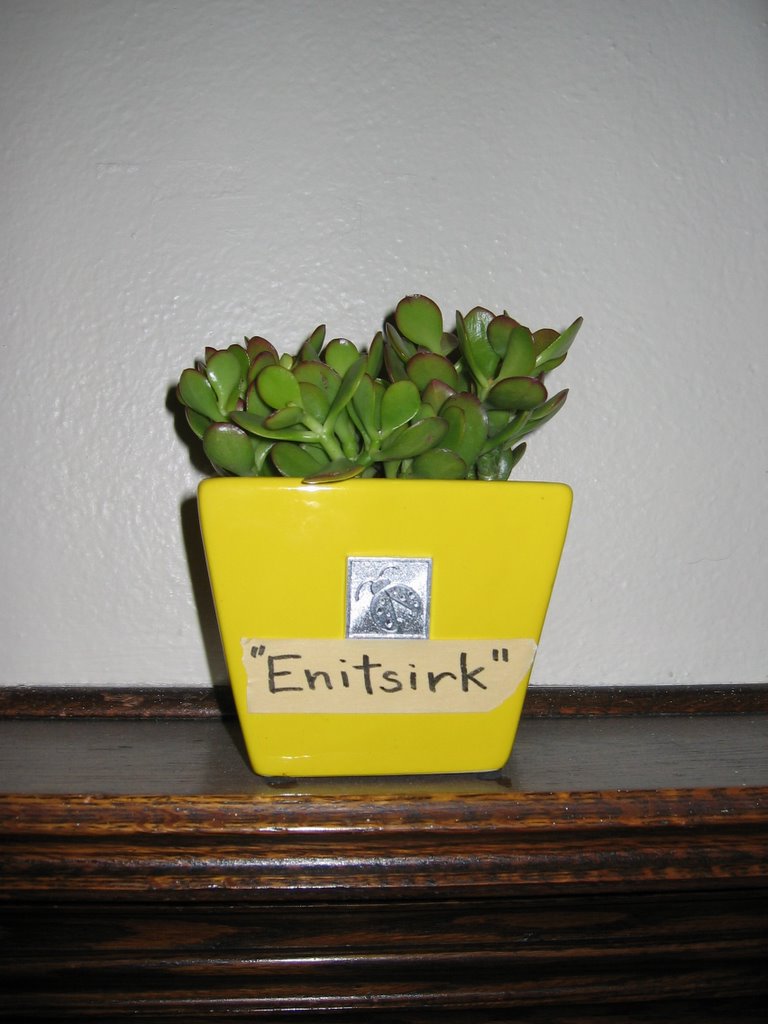
It's a jade plant which is supposedly easy to take care of. We'll see how green my thumb is.
04 February 2006
Pets in the office?
I was thinking that I might enjoy going to my office more if I had something to take care of. A swimming fish would be too distracting (and who will feed it during winter break?) An electronic pet would be too portable (I want to have an incentive to come into the office everyday). My sister often talked about how she would wake up in a panic and run to her lab to take care of her yeast. I asked her about whether I could grow them in my office. Her reply:
Ummm, no. You need a shaker with a constant temperature regulator at round 28 to 32 deg. And you need to prepare all the nutrient solutions, which requires a lab, lots of chemicals, and instruments like pipettes and pH meters. And you need to introduce the yeast culture under sterile conditions, so for that, you need a sterile lab bank (operates under negative air pressure so that the bacteria can't get in). You also need an autoclave to heat the media to 120 deg for about 20 minutes to sterilize the media. You also need a centrifuge to harvest the yeast.
Maybe I'll get a plant! Or I could get a Robosapien!
26 January 2006
Stamp collecting
I'm a pack rat. As a child, I collected rocks (I really like volcanic rocks that have holes in them and shiny rocks such as mica), coins, fantasy art (the late Keith Parkinson is the best!), sea shells (like abalone), and fantasy weaponry (my mom bought me a Highlander katana from Spain last year; I also own a Klingon dagger and a decorative knife from Germany). As an adult, I collect books, music, digital photos, and now stamps!
Here are some of the ones I've collected this past year:


I bought a wee too many sheets (I have 4 sets of the Constellations), so I'm going to contain my zeal next time.
I've discovered that stamps are a great present. They are useful, look cool, and are inexpensive. I've given away airplane and Latin dancing stamps to friends.
Here are some of the ones I've collected this past year:
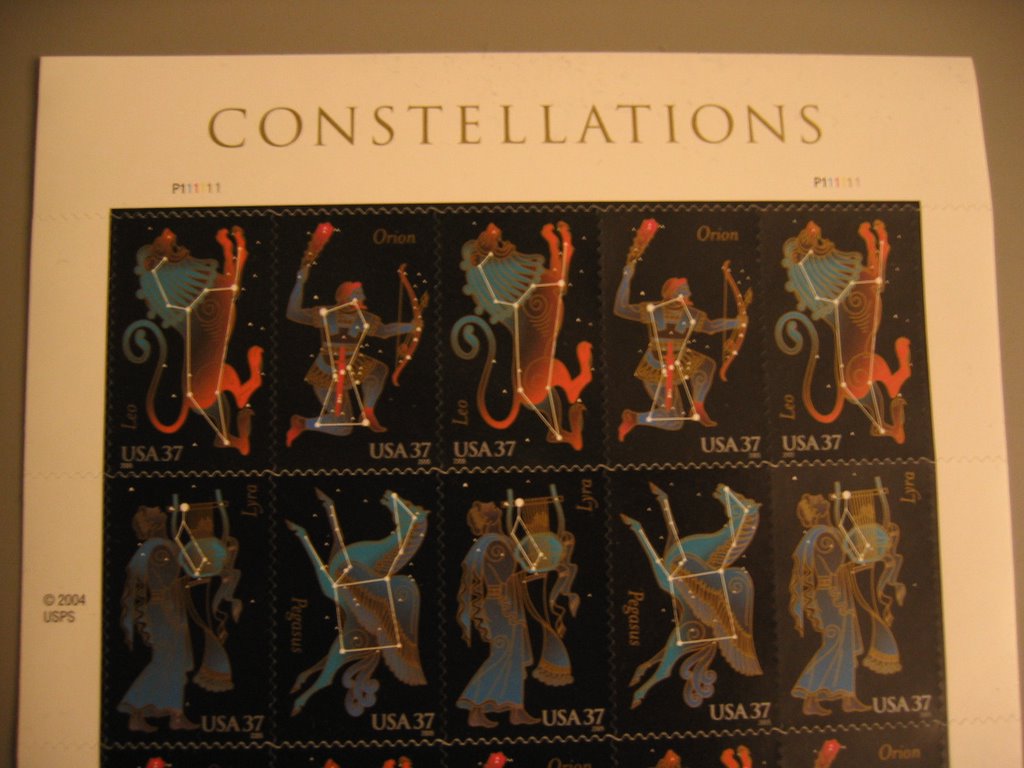
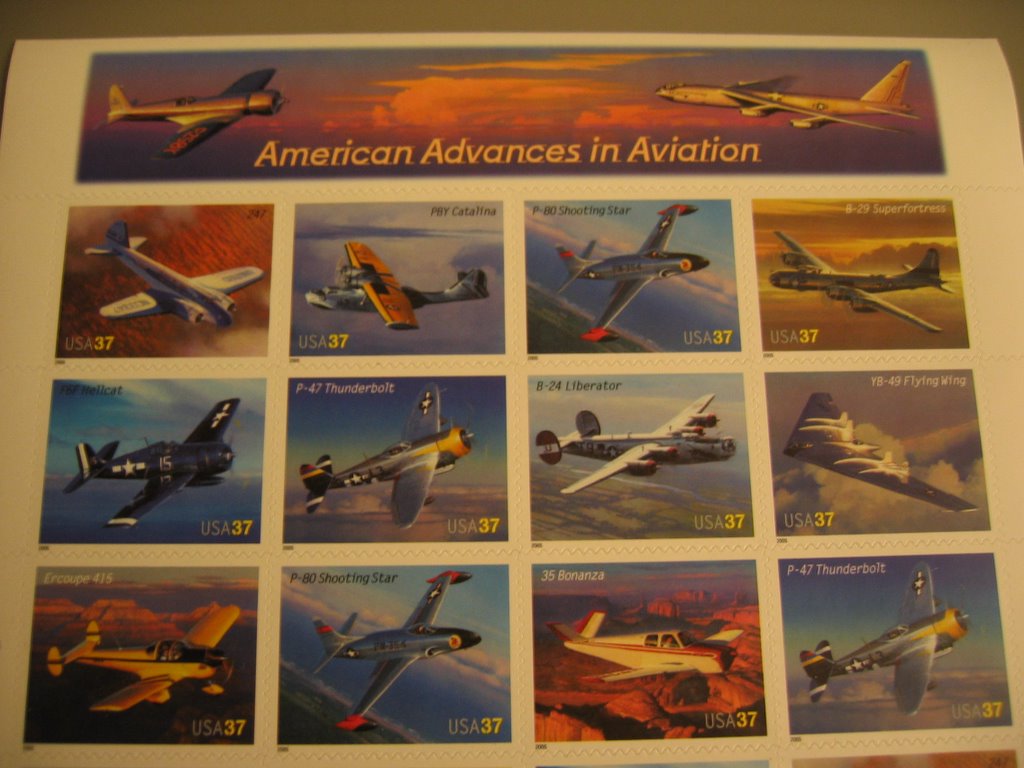

I bought a wee too many sheets (I have 4 sets of the Constellations), so I'm going to contain my zeal next time.
I've discovered that stamps are a great present. They are useful, look cool, and are inexpensive. I've given away airplane and Latin dancing stamps to friends.
24 January 2006
Amateur photography
I like taking pictures. Someday, I'd like to get better at it. I think it would be a cool hobby.
Through an hour's of window surfing, I think the Canon Powershot S80 would be an awesome choice. It's compact and loaded with features, a middle ground between the point-and-shoot ultracompacts and the fancy digital SLRs. Plus, the S80 has wide angle for those breathtaking panoramic shots or large group portraits. Maybe I'll magically find $500 lying around...
One thing I wonder about is the S80's 8 megapixels. That's twice the number of my current camera (a Canon Powershot S400)!!! What do you do with all those extra pixels??!! Will I want to frame my "masterpiece" on the wall? OK, I'll save the speculation for when I get the camera...
Through an hour's of window surfing, I think the Canon Powershot S80 would be an awesome choice. It's compact and loaded with features, a middle ground between the point-and-shoot ultracompacts and the fancy digital SLRs. Plus, the S80 has wide angle for those breathtaking panoramic shots or large group portraits. Maybe I'll magically find $500 lying around...
One thing I wonder about is the S80's 8 megapixels. That's twice the number of my current camera (a Canon Powershot S400)!!! What do you do with all those extra pixels??!! Will I want to frame my "masterpiece" on the wall? OK, I'll save the speculation for when I get the camera...
22 January 2006
Next generation LEGO Mindstorms
The rest of the LEGO product line might be in decline, but at least there's still Lego Mindstorms, the kit that allows you to make programmable, autonomous robots.
Now LEGO is gearing up to release their third version of Mindstorms called NXT (supposedly it will be released in August 2006). Wired magazine has a feature article and there is a blog about NXT as well.
For now, you can take a look at the LEGO robot I built with a partner for a one-month autonomous robotics contest (circa 2001):

Now LEGO is gearing up to release their third version of Mindstorms called NXT (supposedly it will be released in August 2006). Wired magazine has a feature article and there is a blog about NXT as well.
For now, you can take a look at the LEGO robot I built with a partner for a one-month autonomous robotics contest (circa 2001):

11 December 2005
Bring back the old LEGO!
I recall with great fondness playing with LEGO, the plastic bricks with knobs. Most of my sets were from the Castle series and of those, my favorite set was the "Robin Hood" outlaw outpost. I even made a model of Fort McHenry out of Castle pieces! I also had a lot of fun with the Technic series, though I only had one set of that kind.
I was perusing the LEGO website recently. What happened in the last 10 years? There is still a Castle-like series called "Knights Kingdom". But in that series, there are very few large-piece sets. The only one I could find was "Vladek's Dark Fortress." The rest of the sets were very specific, simple things like a single knight "Sir Jayko." Where are the sprawling massive sets of my childhood? How can you be creative with these newfangled LEGO sets?
LEGO seems to have moved in the direction of recognizable labels like Star Wars. It's sad. I'll have to save my old LEGO sets for the next generation.
I was perusing the LEGO website recently. What happened in the last 10 years? There is still a Castle-like series called "Knights Kingdom". But in that series, there are very few large-piece sets. The only one I could find was "Vladek's Dark Fortress." The rest of the sets were very specific, simple things like a single knight "Sir Jayko." Where are the sprawling massive sets of my childhood? How can you be creative with these newfangled LEGO sets?
LEGO seems to have moved in the direction of recognizable labels like Star Wars. It's sad. I'll have to save my old LEGO sets for the next generation.
04 August 2005
International radio operators phoenetic alphabet
Now you can flawlessly communicate your airline confirmation numbers over the phone...
Alphabet:
A - Alpha
B - Bravo
C - Charlie
D - Delta
E - Echo
F - Foxtrot
G - Golf
H - Hotel
I - India
J - Juliet
K - Kilo
L - Lima
M - Mike
N - November
O - Oscar
P - Papa
Q - Quebec
R - Romeo
S - Sierra
T - Tango
U - Uniform
V - Victor
W - Whiskey
X - X-Ray
Y - Yankee
Z - Zulu
Numbers:
0 - zero
1 - one
2 - two
3 - tree
4 - fower
5 - fife
6 - six
7 - seven
8 - eight
9 - niner
Alphabet:
A - Alpha
B - Bravo
C - Charlie
D - Delta
E - Echo
F - Foxtrot
G - Golf
H - Hotel
I - India
J - Juliet
K - Kilo
L - Lima
M - Mike
N - November
O - Oscar
P - Papa
Q - Quebec
R - Romeo
S - Sierra
T - Tango
U - Uniform
V - Victor
W - Whiskey
X - X-Ray
Y - Yankee
Z - Zulu
Numbers:
0 - zero
1 - one
2 - two
3 - tree
4 - fower
5 - fife
6 - six
7 - seven
8 - eight
9 - niner
15 June 2005
Addendum to future projects list
8) Launch home-made rockets. Apparently, this is a hallmark of budding young engineers and scientists. I was supposed to do this as a child, but I'm making up for lost time.
9) Learn to drive and buy a car (probably used).
9) Learn to drive and buy a car (probably used).
Subscribe to:
Posts (Atom)