- You get to spend all your time thinking about one project (once you finishing classes and TA requirements).
- You get paid to learn about cool stuff.
- You don't have any administrative responsibilites (like your poor advisor). Well, maybe the occasional hapless undergraduate research student to supervise.
- You get to travel to nice places for conferences.
- You are surrounded by lots of smart, educated people who are your age.
- You have the most flexible work schedule. (Hmm, how about ditching that colloquium to run to the hockey store?) The downside is that your parents expect you to come home for vacation all the time.
- Another excuse to continue living in that haven we call school.
- More opportunities to dabble in all your esoteric hobbies: art, history, literature, juggling, climbing, politics, music, etc.
- Reasons why it's better to be a grad student than a postdoc: Your advisor cuts you a lot more slack since you're not officially certified (no PhD yet); there is usually a much larger grad school community than postdoc community; you don't have to worry about getting a real job yet; you're still of sufficiently low status to joke around with your professors and not worry about the consequences.
07 May 2006
Why grad school rocks
Since my last post about grad school was depressing, I thought I would write a counterpoint post. Here are some reasons why grad school rocks.


Drink more water
Buy a 32 oz Nalgene bottle. Choose a wide mouth (so you can really gulp that water down) and an outrageous color (so that you notice the bottle). Place the bottle within your field of vision while you work.
Also, a side benefit of drinking a lot of water is that you have to get up to use the bathroom and refill the bottle -- providing a natural break from sitting still.
Also, a side benefit of drinking a lot of water is that you have to get up to use the bathroom and refill the bottle -- providing a natural break from sitting still.
Staying awake
It's 2:30 pm in the office and I'm falling asleep. How to wake up?
- Answer a few quick emails.
- Call my sister.
- Check Bloglines and read a few news updates.
- Exercise, e.g. do dips or pushups, run up stairs.
- Play games (if no one is around) like garbage can basketball, stick handling with a hockey stick, target practice with paper cups, etc.
- Drink water.
- Play music. If no one is around, sing. (Thanks to my sister for reminding about this favorite.)
- Annoy one of my fellow graduate students.
I guess this is the best I can think of now (besides gulping caffeine).
Index card + Ion Pen
Over on 43Folders, Merlin Mann likes to talk about the hipster PDA.
I'm even more minimalist. I like to keep one index card (folded in half) and a Cross Ion Pen in my front pocket. (I'm not the only fan of the Cross ion pen!)
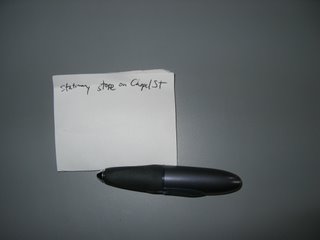
It's pretty handy. When I'm bored during a seminar, I can jot down notes on good and bad speaking skills. Or I can plan my next out-of-town trip. Or jot down grocery lists, etc.
I'm even more minimalist. I like to keep one index card (folded in half) and a Cross Ion Pen in my front pocket. (I'm not the only fan of the Cross ion pen!)

It's pretty handy. When I'm bored during a seminar, I can jot down notes on good and bad speaking skills. Or I can plan my next out-of-town trip. Or jot down grocery lists, etc.
06 May 2006
Change -> E-certificate
If you have spare change, you can take it to your local Coinstar machine. You can get a cash voucher for an 8% fee or better yet, an electronic gift certificate to a store like Amazon.com, iTunes, Starbucks, etc. I'm definitely going for the Amazon certificate next time!
Worker's high
In the last year, I've been under the weather a lot. A cold here, an injured knee there, feeling tired, etc. I don't remember feeling sick so often in my undergraduate years.
Am I getting old or unlucky? Sometimes I wonder if there is psychology at work. When you're working to make deadline after deadline in college, there isn't time to think about being tired or sick. You just go. In grad school, all of sudden you have all this time to think. Much of this is good: I now exercise at least every other day, I read the world news, etc. But I also have more time to sit around and say, "I feel tired, do I really have to work?"
I guess what I want is a balance between switching your brain off and being mindful of everything around you.
03 May 2006
Grad school guide links
Why grad school sucks
I had a discussion with a good friend of mine about why grad school is depressing. I thought I would summarize some of our thoughts.
Graduate school is very isolating. You are often the only one thinking about your project (and occasionally your advisor). The other grad students are stressed out and worried about their own problems, so they are sometimes not very friendly. You are working on a very narrow topic so no one outside your department has any idea what you're talking about. Sometimes even the fellow grad students in your department aren't interested in your research. I still remember running into some grad students and saying, "Hey, today's colloquium is on your research. Are you going?" They just gave me a blank look and said, "No."
Another aspect to your isolation is that your main interaction is with computers, books, and equipment -- not people. Also, the academy tends to have a monkish culture. Even when there are those rare opportunities for casual socializing, professors and students don't really jump on them. I've been organizing a happy hour for my department and I can see the interest dwindling after doing it for a year.
Of course, I haven't even mentioned the stress of qualifying exams, classes, and not knowing what you're doing. I'm also assuming that you're paid reasonably well. I can't even imagine what it's like to be a humanities grad student in New York City. How do those people even pay the rent??
Then there is the problem of always feeling like a failure. After you finish exams and classes, there is no one to tell you "Good job!" You don't get the good feeling of turning in a problem set every week or mastering a class. Progress in grad school is very slow, on the time scale of years, and there is very little feedback. You spend a lot of time trying to learn about your field which is impossible because there are at least a hundred years of research ahead of you. You have no idea what is important. Research is very slow; you can spend weeks on a problem and not get anywhere. You might even find that the problem isn't worth doing at that point. When something works, you quickly solve the problem and move on, so the feeling of success is fleeting.
There are no obvious short-term goals. It's not like medical school where you pass a bunch of classes and tests and then boom you're a doctor. In grad school, all you know is that you're supposed to be keeping your eye on that nebulous, faraway fruit: the PhD diploma.
All of this adds up to a feeling of depression even if you're at a great school, not starving, and have a fantastic advisor.
If you'd like a more light-hearted perspective of suffering in grad school, take a look at the PhD Comics.
I don't want to end this post on a depressing note. I think there are solutions and I hope to come up with some in future posts. The best thing is that grad school is temporary. You will graduate someday. There is (hopefully) a payoff at the end of all this hard work. Just like a minor leaguer working his way to the major leagues, just like the music conservatory student training to become a solo performer -- we have to pay our dues.
Learning the ropes
One of the big hurdles in graduate school is figuring out what the heck is going on in your field.
My sister had the excellent idea of starting a question blog. The idea is to record all your questions in a blog, sort them by category, and update the entries when you have an answer.
Another idea I have is to start your own dictionary. So everytime you come across some new jargon you don't understand, record it and figure out a good definition (something that you understand). Someday, you'll have your own personal technical dictionary. I'm not sure what is the best way to do this: a wiki, a blog, a text file, a LaTeX file?
Career category
I'm starting a new career category in my posts. It will cover topics like job hunting, becoming a more skilled researcher, etc.
For this inaugural post, I will say that it is helpful to think ahead. So if you're an undergraduate, start acting like a graduate student. Start asking pro-active questions and tying together seemingly disparate pieces of knowledge. Similarly, If you're a graduate student, start acting like a postdoc. Start thinking of your own research ideas. If you're a postdoc, start thinking like a professor. It will make the transition much easier.
Of course, if all else fails, maybe you can just marry a superstar professor and rely on nepotism.
Subscribe to:
Posts (Atom)